Episode Transcript
[00:00:00] Hi, guys, and welcome to the Grow Academy. More specifically, introductory into Profit First. So this video is for two different types of people, but you're both going to take a lot out of it. So number one, you might be completely new to Profit first, so you've got to walk away understanding what is Profit first, why should you care? And how it can actually impact and help you.
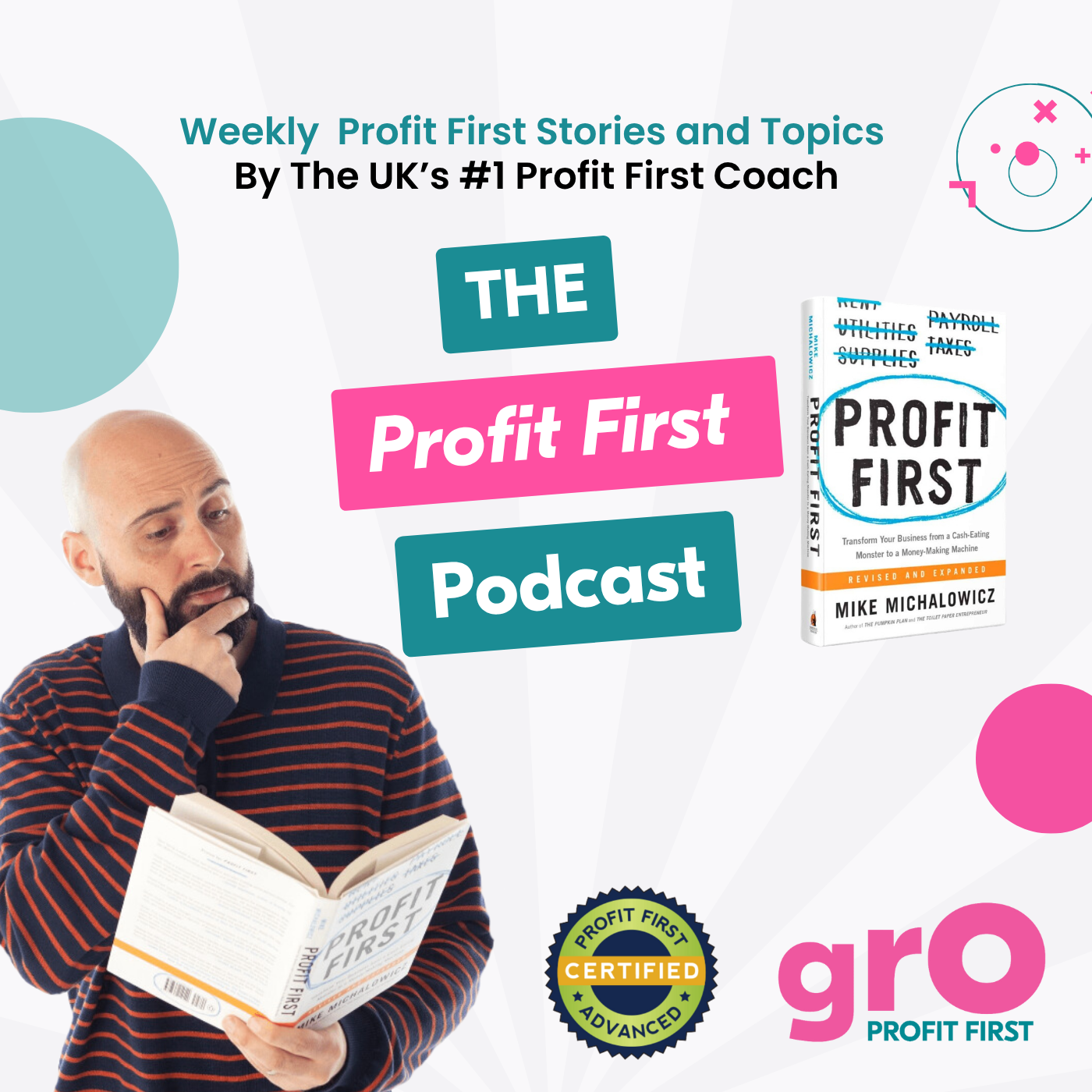
[00:00:22] Or you've decided to work with us for Profit first and we're going to be your Profit first coach. We're to going, going to implement it with you every step of the way. And the the aim for you from the end of this video is to get some quick wins to get started. But either way there's value to be had in whatever situation you're in. So Profit first is based off a famous book by an author, and don't ask me to spell it, called Mike Mallow. And he's American.
[00:00:50] Long story short, he sold a business for several million pounds. He tried to reinvest the money into 10 new businesses. He failed miserably.
[00:01:00] He failed to the point where he was struggling in his family. His daughter actually come down for dinner one day and said, daddy, here you go, you can have my piggy bank. And it was quite an emotional moment for him and he kind of questioned, where did it all go wrong? He thought he had the Midas touch, he thought he knew how to be successful in any business. And he started questioning what, where do owners go wrong when it comes to the finances? And in short, turnover is vanity, profit is sanity. Just because you're growing the revenue does not mean you've got a good business. And he learned there's a different way to run your finances. And there's a way, as it says on the screen on the first slide, to actually, I will walk you through it and hopefully you will be more clued up with how it works. So we are taught as a business owner and common sense really that sales minus expenses equals profit. That's common sense. Of course it is. But the problem is what comes last or what comes first, half last. So it's kind of backwards when it comes to our priorities, with our finances in our business. And because we pull it last, it cause it causes all sorts of problems. And you've probably heard some of the stats that Most businesses, actually 80% of businesses, are surviving on some level. And the main reason for that is cash flow problems.
[00:02:30] And it goes deeper than cash flow problems. And Profit first doesn't unveil some of those deeper root causes. But at the surface level, there are fundamental cash flow problems with, with. And essentially it is a system to guarantee you are profitable.
[00:02:48] So we basically flip the formula. Instead of putting profit last in this equation is second, but we're putting it first because there has to be sales.
[00:02:58] So but what comes first is our profit. So sales minus our profit equals our expenses. And that might sound too good to be true. It might, might sound wishy washy, impractical.
[00:03:12] I mean, give you an example. So if we, let's say it's easy if you're starting a new business. So if you've been running a business for a few years, it's going to be quite hard to get your head around this concept. But if you're starting a new business, it's quite logical because when you do a business plan, you have a very clear target why you are starting that business and what you want and expect to earn. So your business plan might be we're expecting to do 100k in revenue and actually ultimately I've just left a job, let's say, and I know I need to earn £40,000. So in your head, if I'm doing, if I'm doing your reverse engineering everything on day one, if I'm doing 100k in revenue and I need to earn £40,000, that gives me £60,000 for my expenses. So we flip the concept. So that's the kind of old fashioned envelope system.
[00:04:02] So back, back in the day where let's say it's 500 quid, keep it nice and simple and then you might keep your money into different envelopes. £200 might be set aside for your rent, for your mortgage, £50 might be set aside for your groceries, your food shopping, 50 pound might be set aside for utilities and those sort of things.
[00:04:24] I don't know, £50 might be set aside for your discretionary spender money. But you get the point, some of it might be set aside for your savings, for your motor expenses. So that's really how Prof. First works. We, first we are saying what is the profit we're looking to achieve?
[00:04:39] And then secondly we're using the envelope system to put it into different buckets, different pots, so you know exactly where you stand financially at all times. And I would explain this in a bit more detail, but it, if you're using something like Stalin or Monza, it can do, it can be different pots, it doesn't need to be different bank accounts, they might call it different spaces. So let's say I use £100,000 as an example.
[00:05:09] We want £40,000 worth of profit. But we, we then know we need to set something aside for tax, we might need to set something aside for vat and we certainly need to set something aside for our expenses.
[00:05:22] So we're going to have the different spaces for those different categories and on a weekly basis, we're going to divvy it up. But instead of putting it into envelopes, we put it into different bank accounts. And out of sight, out of mind, employed in the past. And you get stopped tax on a monthly basis, you don't pay that much attention to the tax you've had stopped. You might do at the beginning, but you get to the point where you know what hits your bank. Out of sight, out of business with. And we siphon off the profit first.
[00:05:51] So let's say for a week, a thousand pound hit your bank account. It might be that 50%, 500 quid is, is your profit, and we siphon that off first.
[00:06:02] But when we're talking about profit first, there are different pots, there's different accounts. So when I talk about your profit, there's. There's really three different elements, because these three things serve you as the owner. You've got your profit, you've got your owner's pay and you've got your tax.
[00:06:20] So those three categories on my screen, they all serve you. You. So you know, your accounting profit might be, I don't know, £50,000 for a year. You know, as an example, however, you've got to pay tax. So it might be that £10,000 of that is your tax.
[00:06:40] So you. So you've got £10,000 worth of tax. At that £50,000, that leaves you £40,000 out of the £40,000, you need to live off that money on a monthly basis.
[00:06:52] So if you're paying yourself that money every single month, every single week, which most of us do, we've got living expenses. We call that owner's pay. So your owner's pay, yes, it's coming from the profit, but it's what you're paying yourself on a regular basis. And as if you were an employee in your business, it's kind of your wage, it's your owner's pay. Yes, it's coming from profit, but it's for you working in the bit or paying themselves something through owner's pay. Most people are having to pay the attacks because they'll be in trouble if they don't. But what most people don't have is a separate pot of money just for your profit. This extra pot of money, this bonus, a Little bit of money just sat there every three months. And this is what we teach people to do. So I do my own business and, and at the beginning it might be something small to the point where actually there's quite nice big things that you could reward yourself with. It could be you build up your profit pot and you do something big with it at the end of the year. But the point is profit is separate with profit first to what you normally pay yourself. The other two main accounts are your income account, so we'd have an account for when your income comes in and your expenses account.
[00:08:05] So they are the core accounts. When it comes to profit first, there can be additional accounts.
[00:08:11] And how does it work in practical terms? So we would normally recommend either twice a month or any hits, your bank account.
[00:08:20] And we have, we, we've got a spreadsheet, a template or an app, depending on what's best for you, where if you put a thousand pounds into the spreadsheet or the app, it automatically figures out the pots.
[00:08:34] So the people. If we're going to work with you, if profit first, don't worry, we will figure all of that out for you. If you're just watching this and you're learning about profit first, we can send you a free copy of the book and learn, you know, a bit more in depth how it all works. But there's a way of figuring out exactly what should you set aside for your business. So you know what to set aside for vat, you know what to set aside for tax, for expenses, you know what to pay yourself. And there's money set aside for profit every single week or every single or every or every two weeks. So every week or every two weeks, you know what to set aside. And basically all starts with your income account. It goes into your income account and we figure out what to split off and put into the little pots. That's how it works in practical terms. Again, if we're going to be working with does over time, it forces you to run your business differently, it forces you to, to innovate cash flow problems. You're going to be a lot more strategic, you're going to be a lot more attentional and you want to get more out of your business. And we see and there's a few on the screen there, this was a really big one. This business saved £200,000 in the first quarter. They started working with us and comes in the business and they save £200,000 by thinking differently almost instantly. Because when you think about it through the profit first lens, you're taking a step back and not everybody makes savings like this. For the record, it depends on how big your business. It depends on your revenue. You know, for a rough idea, if you're a quarter of a million revenue business, we would be disappointed if you're not £20,000 better off within 12 months. And it can be a lot more than that. It might be a bit less, but it's all relative. You know, even if you're five or ten thousand pounds better off, this is money that's going to go into your pocket as sort of cash flow, stress. And we've got some other examples.
[00:10:29] So we've also. It's not on the screen, but we've. Oh, that there it is there. So we had a business, they were, they were seven years into the business, a very big business, actually never made a profit. They made the first profit in the first quarter. When we done profit first with them, we had a coffee shop client that went from one shop to two shops, doubled their, doubled their profit as well as their locations. But they actually worked less in the business. They weren't involved in the business on a daily basis, had a lot more freedom and a lot more money.
[00:11:00] And with these stories, it's not kind of a dream destination. You go there and you're in, you're, you know, you're on a beach and life's just amazing forever. There will still be challenges. It not going to solve all your problems, but what I can promise you, it will make your problems a lot easier. And it is almost my next video where I talk about the mindset for Profit first will determine your successes in your business. But for if you've got the right business model, because we can't promise you've got the right business model, sometimes profit first teaches you that actually you might need to do something differently. But if you've got the right model and you're consistent and you're willing to make a change, that then 90% of the time you are going to get those results. It's also about changing the way you think when it comes to numbers. So here's the quick wins, here's how to get started. As I keep on saying, if we're working with you one to one, don't worry, you don't have to do anything. We, we, we're going to walk you through every single part of the process.
[00:11:59] If obviously it's up to you how much action you take. But either way, here's some quick wins anybody can do.
[00:12:05] You know, even if we are working with you of profit first. Here's some things you can do to hit the ground running really quickly. And so that sounds really, really obvious but when was the last time you went through your bank statement line by line? Most business owners are not doing this. Particularly if you're quite techie and you're into AI, you're into subscriptions, you're into software. Then you need to go through and just filter through and figure out. It's a bit like I go into my wardrobe every few months and I throw away, throw away a lot of stuff.
[00:12:37] And you need to kind of look at your business through the same lens. And you need to question when you look at the expenses is there's two types of main expenses. A must have or a nice to have. But there's also something you're looking to get a return on.
[00:12:51] So for example, let's say someone were investing in profit first to work with us.
[00:12:57] It's not a must have, but it's not a nice to have. It's something you want a return on. You want to make more money you in your business by investing in that thing. Marketing might be the same thing. If you're spending money on marketing you should be for some form of return. So look in your expenses. Most people can save on later on if you cancel it. You know some extreme if. If your business is struggling and hopefully you're not in that situation. But if you're really, really, really struggling, one option is to almost, almost cancel everything and then add in what you need almost starting from scratch. Because we, we build up over time in our business. But I wouldn't recommend that for 99 of people. Also start setting 1% aside. So start putting 1% aside.
[00:13:50] You know, 1000 pound would be 10 pound you'd set aside a week because there's all minute on 99%. So that is actually what Mike Mallow recommends himself. So that is a way of getting started. In terms of the bank accounts.
[00:14:02] Starlin Monzo, Metal Tide. An account where you can have pots or spaces will make your life so much easier. You don't need to open all these different bank accounts. They will let you split it into pots. You could just have a pot for for profit. There is some advanced tips we recommend for people later on strategies. I have a bank account for my profit tax that I don't even have online banking for because if I transfer it across, it's not easy to log into, it's not easy to take the money out. So that's not a bad idea. Transfer that 1% to an account that's not easy to access. Mike McCalowich famously talks about in the book that it's so difficult to take the money out, he has to walk to the bank. I mean, I guess he could drive there, but he says I've got to walk to the bank. And he calls it the walk of shame. I got walked to the bank and I got to take that money out. So make it difficult to access this little, little extra pot. Putting 1% aside straight away, you. There's also no excuse not to be separating your VAT just from separating their vat. If you, if you're running a business and you're struggling with your VAT bill and your VAT bill is mixed, your VAT money is mixed into your main account.
[00:15:11] It's a, it's problem. The best things you can do is have a separate account for your VAT and you know exactly how much to set. For example, you know for every, let's say it's 10% roughly what you owe the VAT man compared to what hit your bank. And I know VAT is 20% but obviously it depends on, because it's a, it's 10 of what hits your account. So if you've got 10 grand that hits your account, 1,000 pound would be set aside for VAT and then 9,000 pound is what is left to do your allocations. You take away the VAT first. So separate the VAT first. Okay. If you, if you're wondering what is your percentage for vat, reach out to us and we can have a look if we do your bookkeeping or if we figure that out. But there's no reason why you can't get started separating something for your VAT because it's one of the most important things you can do. As I said, open up your accounts. You've got your profit account, your owners pay your tax, your operating expenses, your income account is not showing on there, they're the five big ones and then your VAT account 6. If you are VAT registered, there might be more accounts later on depending on your circumstances, but they are the main accounts.
[00:16:24] As I said, I call it accounts, but it can be spaces or pots. If you open an account with someone like Monzo or a Modern bank account and it's just starting small, build in the rhythm. So even if you're waiting for us to do your assessment, I'd love you to get started with some of the things I've talked about. If you're new to profit first and, and you don't know what I've been talking about for the last 20 minutes.
[00:16:47] Set aside your VAT money. Here's a profit assessment.
[00:16:50] So we look at what you're doing in your business at the moment, we figure out what you're paying yourself, what most people have not got a profit pot. We figure out what your extra profit pot looks like, and it's zero for most people. We figure out your tax, how much that's been, what you've been setting aside for vat, your operating expenses, and we let you know what is possible. And it might be that we are aiming for 60% of the real revenue. And the difference between 80% and 60% can be tens of thousands of pounds. It can be a lot of money. So when we do your profit assessment, we look at the last two years, we take a deep dive, we really drill into the numbers and we give you a plan on how to improve your percentages month by month so you know exact. And we do it in a way that the changes are so small you don't even notice it. So that's how it works when we do a profit assessment. If we're doing that with you, we will be in touch very shortly to explain exactly how it works. If you want some more support on your own profit assessment, please reach. Just read the book and have a go yourself. So there's lots of different options.
[00:18:00] Okay, So I know this for some people might be overwhelming, but you don't need to do everything at once. You just need to get started. You just need to start making those small changes. But ultimately.
[00:18:12] So the main thing I want to leave you with is the reason we're so passionate about Profit first is most business owners are surviving on some level. I've seen so many cases where the employees are earning more money than the owners.
[00:18:27] A lot of owners are earning close to minimum wage, if not less, because of the hours they're putting in. And that doesn't take into account the energy it takes from them. You know, the mental stress we are as owners. It's common for us to wake up in the middle of the night thinking about our business. Do the things you want to do. And that is what Profit first is about. So it's not. It's not really about a book, it's not about a system. It's about how can we help you make more money or how can you help yourself make more money so you can enjoy your business and ultimately give. Give yourself the, the life you want. So, see you in the next video. Cheers, guys.